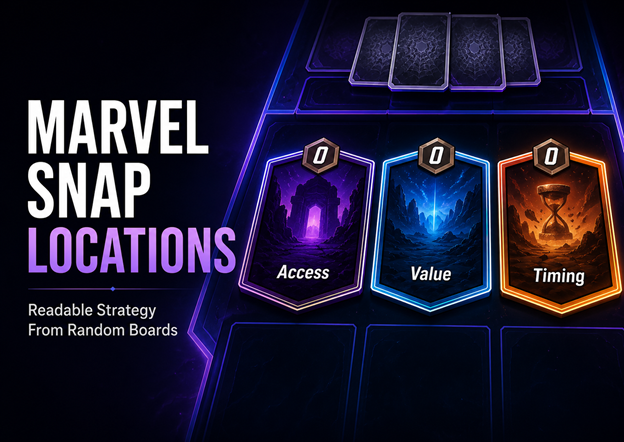
Marvel Snap locations are not background flavor. They are the match’s second hand, revealed one lane at a time, changing what every card means before the players know the board. A mediocre hand can find a lane it was built to exploit. Strong location play is usually less about memorization and more about reading uncertainty early.
The useful distinction is between randomness and unreadability. Randomness means information arrives in an order the player cannot fully control. Unreadability means the player has no fair way to respond. A study on
player uncertainty in digital games frames uncertainty as something players experience through hidden information, chance, exploration, and their own understanding of what to do next. Marvel Snap locations work because they reveal enough rules to make uncertainty playable. Lane text tells you what changed. Your hand tells you what can adapt. The cube count tells you how expensive confidence is.
Readable Randomness Across Fast Games
Fast games need clear signals because decisions arrive quickly. Marvel Snap does this with location text, lane limits, turn order, visible power totals, and the snap-retreat layer. A player does not need to love a location to learn from it; they only need to understand what it asks of the board.
The same principle appears in online slots, where uncertainty is presented through visible reels, symbols, paylines, bonus labels, and feature names.
Bovada slots is a dedicated online slots section with classic three-reel games, modern five-reel games, Ways Pays titles, Hold & Win formats, progressive jackpot formats, and Hot Drop jackpot slots. Used as a comparison point, Bovada slots shows how another short-session format makes random outcomes easier to follow through named structures and immediate visual feedback.
In Snap, a location such as Bar With No Name or Death’s Domain rewrites the value of normal power. In slots, feature language helps explain what kind of symbol behavior or bonus pattern the game is built around. Both rely on uncertainty, but both become more readable when the rules are visible before the result finishes playing out.
This
2025 recap of top slot features continues the same idea with examples. Fruit Fortune is described through stacked symbols, expanded wilds, and 100 paylines. Super Sugar Pop: Hold and Win centers on a collection-style bonus structure. Book of the Damned and Faded highlight expanding symbols and free spins. Slasher and Berry connects horror-parody art with cluster pays and changing symbol flow. Beside Marvel Snap, those examples show why presentation matters: a mechanic lands better when the player can see what changed and what outcome the game is inviting them to track.
Locations Change What Your Deck Is Saying
Image source: Original graphic created by us for this article
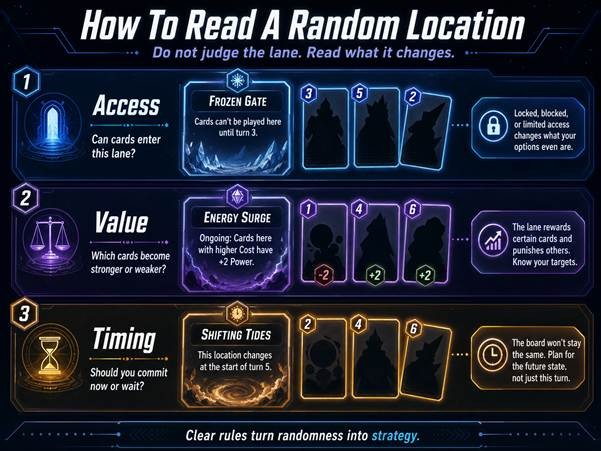
Every Marvel Snap deck has a preferred sentence. Destroy wants material to break and payoff cards to reward it. Move wants space, timing, and landing lanes. Ongoing wants stable power that survives into the final reveal. On Reveal wants card order to matter. Locations interrupt those sentences, but they also reveal whether the deck has another way to speak.
A location-aware player does not ask, “Is this location good?” That question is too flat. The sharper question is, “What does this location make true?” If Sanctum Sanctorum appears, reachable power matters more than normal placement. If Kamar-Taj appears, On Reveal cards may become more valuable than raw stats. If Negative Zone appears, low-power support cards carry a different cost. The location is a temporary grammar for the match.
| Location pressure |
What it changes |
Smarter reading |
| Access limits |
Where cards can enter play |
Preserve flexible reach |
| Power modifiers |
Which cards scale cleanly |
Revalue small bodies and buffs |
| Trigger changes |
How effects repeat or fail |
Delay key cards |
| Hidden information |
When confidence is justified |
Snap later if the final lane matters |
Best Players Treat Lane Text as Tempo
Tempo in Marvel Snap is not only about playing on curve. It is about spending information well. Sometimes, the best turn 2 play is not the highest immediate value, but the card that keeps future lanes alive. Sometimes, skipping a flashy combo line is correct because the third location can still collapse its landing spot.
This is where the
location database becomes useful as a training tool. Studying location effects in groups helps players recognize families of pressure: restricted lanes, duplicated cards, altered costs, forced movement, destruction zones, and power swings. Once you see the family, you can react faster because the board feels less like a surprise and more like a familiar question wearing a new name.
Randomness Is Skillful When the Rules Stay Visible
A lesson of Marvel Snap locations is that randomness does not erase skill. It tests how quickly a player can update. The first lane gives direction. The second lane challenges the plan. The third lane prices the decision. By the final turn, the player who read the board early has more than better cards; they have a cleaner story of why each card belongs where it is.
That is why locations remain one of Marvel Snap’s smartest design ideas. They make every deck prove it can think under changing conditions. They turn memorized lines into live judgments. They keep short matches from feeling solved. Good randomness gives players something to read, and that connects with research on
digital game elements, user experience, and learning.